Dominant systems don’t give up their dominance willingly….we’ve inherited and still contribute to many dominant power systems (whether consciously or unconsciously):
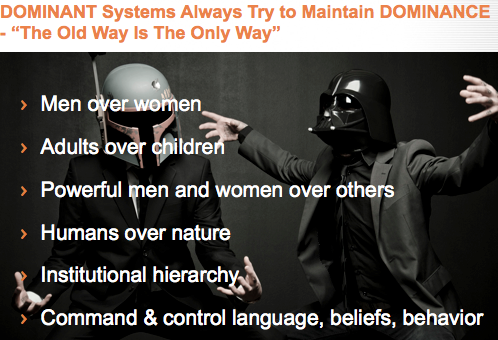
reference the impactful work of Dr.Robert Gilman and the Context Institute: http://www.context.org/about/
“One of the great liabilities of history is that all too many people fail to remain awake through great periods of social change. Every society has its protectors of the status quo and its fraternities of the indifferent who are notorious for sleeping through revolutions. But today our very survival depends on our ability to stay awake, to adjust to new ideas, to remain vigilant and to face the challenge of change.”
– Martin Luther King, Jr.
It is important that I/we continue to be more awake/aware of and learn how to shift the balance of power more effectively, more generatively, more strategically to help communities (business and social) accelerate through the “transition.” Why? to accelerate through the resistance and suffering to minimize the delay/waiting (which causes permanent damage) and to increase likelihood of achieving their/our desired outcomes.
Dominant Power Structure Transitions:
- 1) anarchy 2) oligarchy 3) & now polyarchy (for greater adaptability and anti-fragility in the face of volatility, uncertainty, complexity, and ambiguity)
Why am I & so many others complicit with protecting the status quo of our established oligarchies? Are we benefiting so much in the short term that we are unaware that our delay is costing us and our communities…are we assuming a delay won’t cost us?

Does my own lack of curiosity about my potential lack of curiosity re: competing commitments and unexamined assumptions keep me trapped in the bondage of delay/bystandering (disguised as innovation leadership and strategic work-to-do) too? As a believer in the impossible I have to also believe that I CAN also be trapped if I don’t sufficiently examine my own contribution to the collective contradictions and “immunity to change.” So….
I am continuing to explore how to apply the theory of power, politics, leadership and “REVOLUTION” to corporate strategy – it is important ask where we might find the most business value from increasing our attention to this….explore this “for the sake of what? para que?”
…. H2 (how to) accelerate the shift to a desired balance of power that creates the environment necessary for transformation (cultural revolution) to be more innovative, adaptive, anti-fragile & competitive in the “new normal?”
… said differently, H2 strategically alter the composition of power structures in command & control regimes by providing alternative structures that are more adaptive, agile and align with the community of people’s wishes vs the wishes of an elite and potentially outdated hierarchy?
– H2 help objectively identify the current power strx & impact on goals? migrate to a new strx? in favor of who/customer? options for power strxs?acknowledgement that one power strx to rule them all is dangerous?
– H2 accelerate revolutionary movements BEFORE business communities reach their breaking point of maximum suffering?
– H2 help leaders better understand their contribution to consent/fear/learned helplessness?
– H2 accelerate dislodging/awakening of involuntary consent/obedience – self-determination theory?
– H2 build authentic case for change/purpose/etc new CEO levers & sources of certainty in an uncertain time?
– H2 understand co-evolution = empowerment, responsiblity, learning, sharing, micro feedback loops to drive emergent (macro) best practice behavior?
– H2 design for spontaneous recreation of order (too much environmental constraint/perceived dictatorship)?
– H2 design complex adaptive systems, pushing for whats better for the whole?
– H2 anticipate where/when pressure point is reached?
– H2 make sure the emergent/self-org behavior happens in a productive/generative way?
H2 Change habits and patterns of obedience?:
-
• replace passive submission to self-respect and courage
• show the populace that their assistance makes the existing regime possible
• build determination to withdraw cooperation and obedience
Nonviolent struggle both requires, and tends to produce, a reduction of fear of the opponents and their violent repression. The diminishment of that fear is a key element in destroying the control by the opponents over the population.
Business politics is of course, an understanding of how power works and business transformation = social revolution. Many would benefit from knowing my new friend Jamila Raqib and Mr. Gene Sharp from the Albert Einstein Institution – non-profit in Boston:
http://www.aeinstein.org http://www.aeinstein.org/english/
My favorite video of Gene’s: https://www.youtube.com/watch?v=QQV_4-rXXrE
I have just begun to collaborate with Jamila at the Institution after years of studying their work and years of working on transformation/innovation with purpose based leaders at great companies and at West Point, the Context Institute, Chief Learning Officers, Chief Strategy Officers, CEOs, the Conscious Capitalism organization and studying Mr. Gene Sharp’s books/videos, Jackson Katz, Sheryl Sandberg, and starting with MLK…all to help learn/experiment with structuring corporate and community transformation strategies around how these leaders have been teaching the world “how to start a revolution.”
Outlining Gene Sharp’s macro approach to desired power shifts:
-
1) stgy + alignment to the stgy is key vs passionate improvisation
2) overcome atomization (sense of connectedness, environment of trust, “boatcrew”)
3) shift pillars of support for current dominant strx (to be more generative/adaptive on behalf of community vs elite)
4) Resist violence = remain anchored in PURPOSE & VALUES so as to not waste time w/distracting drama
5) Political jiu-jitsu = enable making the competing commitments more visible – the dominant “regime” will alientate more people by insulating self, keeping info, maintaining silo’s, self protection will be its demise & evidence
6) Don’t give up – see it through – flexible in tactics to keep momentum moving forward
This is a great/related & recent tedtalk with context of business:
Far too many Americans are illiterate in power — what it is, how it operates and why some people have it. As a result, those few who do understand power wield disproportionate influence over everyone else. “We need to make civics sexy again,” says civics educator Eric Liu. “As sexy as it was during the American Revolution or the Civil Rights Movement.”
Potential Hypothesis
-
– shifting the balance of power to a focus on the customer is where you get business value, traction, momentum – I am focused on continuing to discuss H2 build strategic assets/competency/strategic initiatives that are rooted there first to give your community even more power in the business conversation that other leaders will also respond to – I think that might be the most legitimate way to get traction and tangible business transformation.
The business value of practicing with this is:
– the ability to better manage powershifts deliberately for the sake of better business outcomes
– recognize when its happening & anticipate the impact of them
– is it valuable enough to have a group of executives with the vocabulary necessary to have these conversations without the FEAR of losing power (which could cause avoidance altogether) AND to have the conversations prior to being in the crisis?
 INNOVATION LEADERSHIP
Power is a subject that is surrounded by mystery, not many people think of it as a subject to be studied. Leadership education comes short not only in power but other dimensions of leadership as well.
Arnold Mindell’s view of power as fluid has help me to have a different relationship with power awareness. Sometimes is fixed, in the cultural sense, but on the micro level (within interactions in relationships and groups) has such a dynamic quality. Which makes power such an interesting and necessary area of study. And by study I mean in two ways, theory and practice. Not only understanding it, but also embodying the awareness of the influence of power dynamics.
Culture, Change, innovation, power… organizations are faced with the need of understanding its own humanity.
Excellent post Raff. Big ideas and a lot of work to do.